Flood Hazard Mapping service specifications
Find FHM service tutorial here.
Service Description
The Flood Hazard Mapping (FHM) service generates a set of enhanced flood hazard maps by merging modelled hazard maps from the Global River Flood Hazard Maps dataset 1 and the empirical flood frequency map derived from the Flood Frequency Mapping service based only on Sentinel-1 data. The Global River Flood Hazard Maps dataset was produced as part of the Global Flood Awareness System (GloFAS) of the Copernicus Emergency Management Service (CEMS). They relied on input river flow data provided by the open-source hydrological model LISFLOOD, while inundation simulations are performed with the hydrodynamic model LISFLOOD-FP.
The FHM service produces a set of enhanced flood hazard maps, expressed as water depth maps, for nine different return periods: 1-in-X-years where X equals to 2, 5, 10, 20, 50, 75, 100, 200, and 500. Table 1 compares the difference between the Global River Flood Hazard Maps dataset (henceforth referred to as GloFAS flood hazard maps, for the sake of clarity) with the FHM service of CopernicusLAC.
| GloFAS Global River Flood Hazard Maps | CopernicusLAC’s FHM service | |
|---|---|---|
| Return periods | Seven (10, 20, 50, 75, 100, 200, and 500 years) | Nine (2, 5, 10, 20, 50, 75, 100, 200, and 500 years) |
| Spatial resolution | 90 m (3 arc seconds) | 30 m (1 arc second) |
| Tiling and coverage | Fixed global grid (10 ox10o tiles) | Dynamic area of interest (custom regions as needed) |
| Data format and catalog | GeoTIFF (standard format) | Cloud-optimized GeoTIFF with STAC Catalog support |
| DEM reference | SRTM 90m | CopernicusDEM (GLO-30) |
The service integrates empirical flood observations derived from Sentinel-1 satellite data with model-based inundation scenarios from GloFAS (CEMS). Flood extent maps are first reconstructed from Sentinel-1 imagery through the Flood Extent Mapping service 2,3,4, and a flood frequency map is computed over a historical archive exceeding 10 years via the Flood Frequency Mapping service. The FHM service automatically retrieves the Flood Frequency maps from the dedicated STAC collection hosted in the CopernicusLAC Platform.
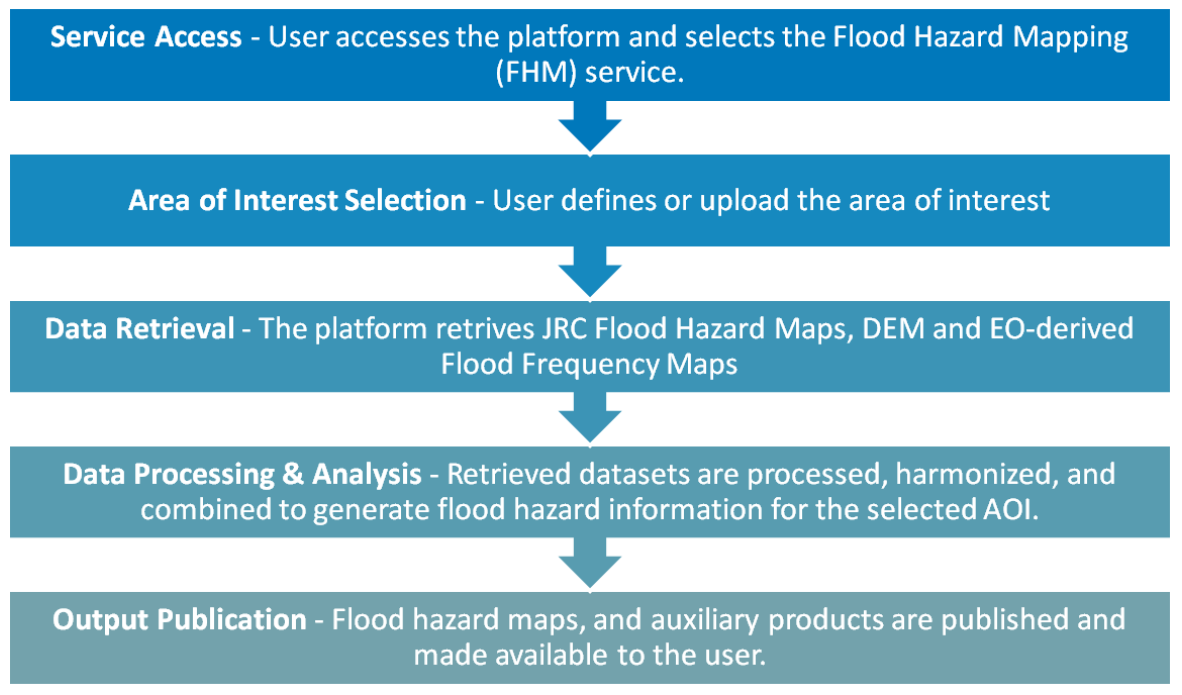
Sequence schematic of the FHM service.
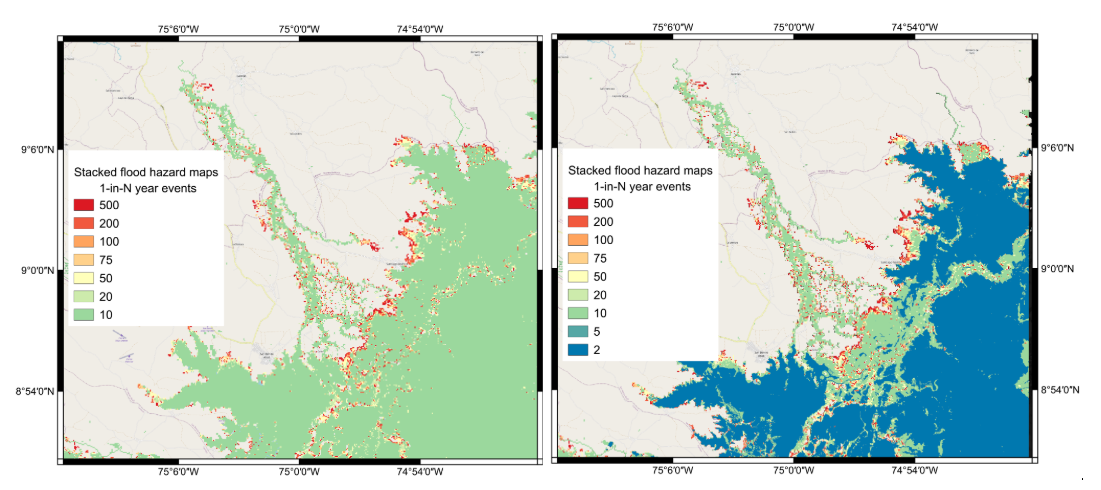
From this empirical frequency map, flood extent maps corresponding to low return periods (2 and 5 years) are derived, and associated water depths are estimated through the Flood Depth Mapping service. These EO-based products, specifically the 5-year flood extent map, are then combined with the GloFAS model-based hazard maps for the higher return periods (10 to 500 years), over which water depths are recomputed accordingly based on reference DEM 5. The full set of nine return period maps, combining the empirical reliability of satellite observations with the spatial consistency and completeness of hydrological and hydraulic modelling, constitutes the final output of the service. The main benefits are expected for low return periods maps as shown in Figure 2.
Workflow
The schema shown in Figure 3 in this section describes the high-level workflow of the FHM service.
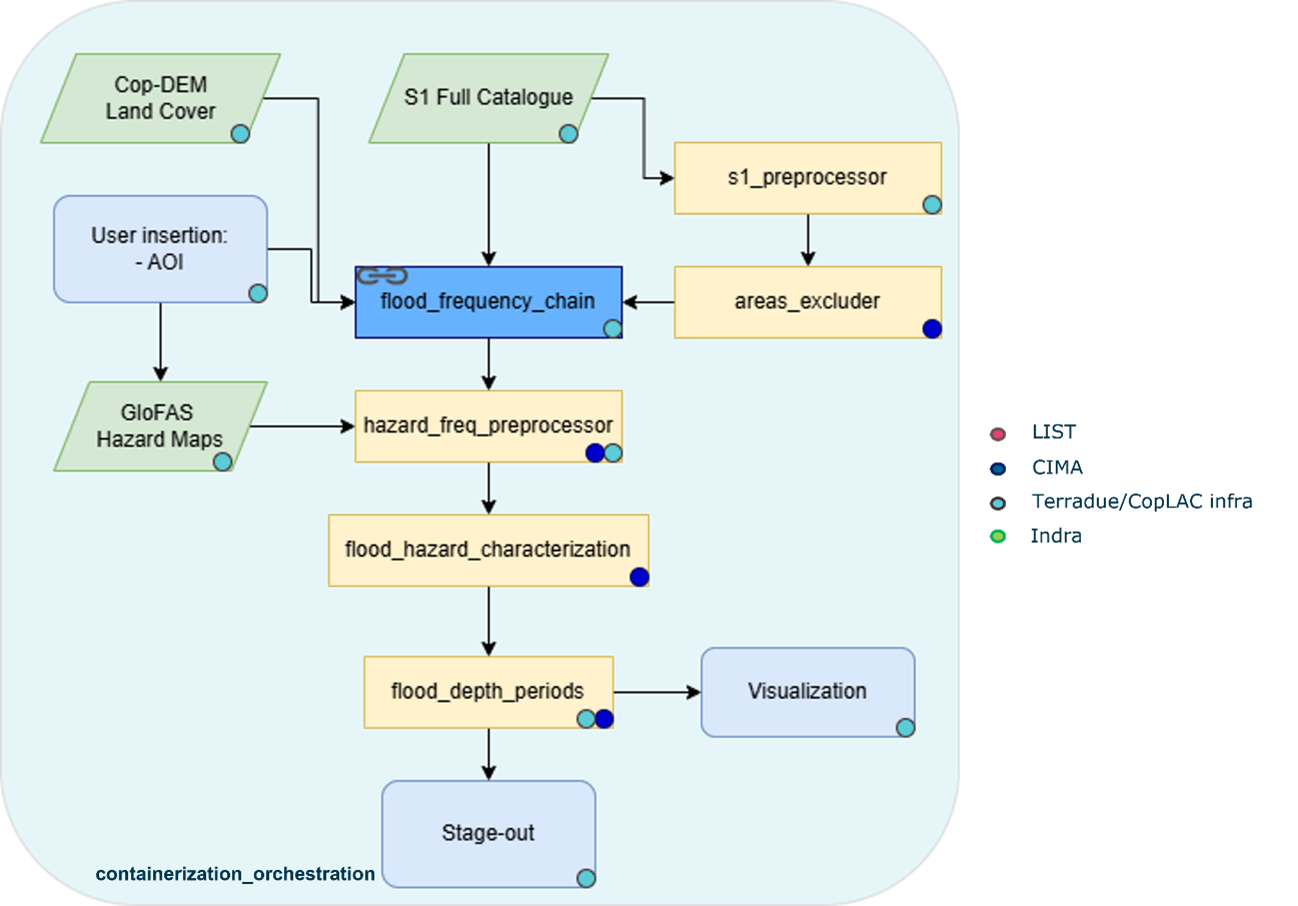
Below are given details of each step of the chain described in the FHM workflow.
-
Frequency maps search: platform component that searches within the user defined AOI all the available input flood frequency 5x5deg tiles from the hosted
flood-frequency-mapsSTAC collection, -
GloFAS tiles search: platform component that searches within the user defined AOI all the available input GloFAS flood hazard 10x10deg tiles from the hosted
glofas-flood-hazardSTAC collection, -
FFM and GloFAS maps Alignment: module that reads the STAC items of the reference GloFAS tile and the flood frequency products, mosaic the frequency layers, resamples the GloFAS assets (i.e. 7 layers of flood hazard maps) to the mosaic resolution, and crop all outputs to the user-defined AOI, and produces two output STAC items: (1) resampled and cropped GloFAS assets and (2) cropped and mosaicked flood frequency assets.
-
COPDEM data mosaic: module that create a mosaic from COPDEM tiles over the AOI.
-
Flood hazard characterization: module that generates low return period extents, 2 and 5 years, from the input Flood Frequency map. Flood extent maps for 2-year and 5-year return periods (RP2, RP5) are produced through systematic probabilistic classification of the (cropped and mosaicked) Flood Frequency raster. The Flood Frequency map is constructed from 10 years of historical flood observations, providing an empirical basis for probability estimation. By thresholding the frequency map at 50% and 20% annual exceedance probability, respectively, this module can delineate spatial zones representing frequent flood hazards—RP2 areas inundated in approximately 1 in 2 years, and RP5 areas flooded in approximately 1 in 5 years.
-
Flood Depths Estimation: module that provides an extension of High Return Period Flood Depths via Water Surface Elevation Interpolation. High return period flood depth maps (RP ≥ 10 years) are generated through a three-step WSE-based interpolation and extension methodology:
-
Seed definition - flooded pixels are identified from GloFAS flood hazard maps (thresholded at 5 cm minimum depth) and combined with the RP5 flood extent raster, defining a target inundation zone.
-
WSE interpolation - WSE is computed at seed pixels (WSE = DEM + depth), then propagated to newly flooded pixels using distance-weighted nearest-neighbor interpolation, ensuring spatial continuity across the extended extent.
-
Depth recovery & validation - final water depths are calculated as WSE minus DEM, with minimum (5 cm) and maximum (10 m) thresholds applied to remove spurious or physically implausible values.
This approach leverages the spatial pattern of GloFAS data, and high-resolution DEM and satellite-derived flood extents for low-RP flood hazard maps.
-
Input
The following inputs datasets are employed by FHM service:
Flood Frequency Maps
The service automatically ingest Flood Frequency Maps STAC items from the flood-frequency-maps STAC collection hosted in the CopernicusLAC Platform.
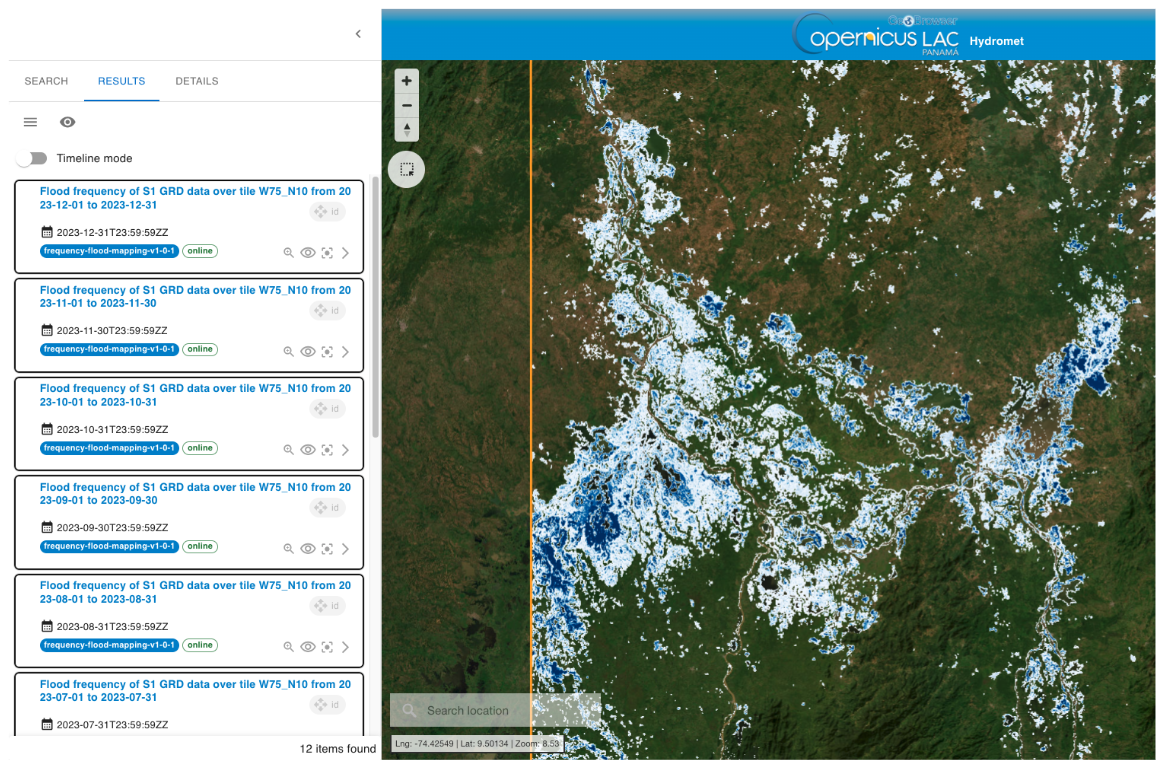
Each items contains:
-
Data Count Map (asset
observations), -
Flood Count Map (asset
water_count), -
Empirical Frequency Map (asset
frequency).
All these assets are at 20m resolution in geographic coordinates (EPSG=4326).
GloFAS global river flood hazard maps
The service automatically ingest GloFAS Flood Hazard Maps (flood inundation depth maps along river network, at seven different return periods) STAC items from the glofas-flood-hazard STAC collection hosted in the CopernicusLAC Platform.
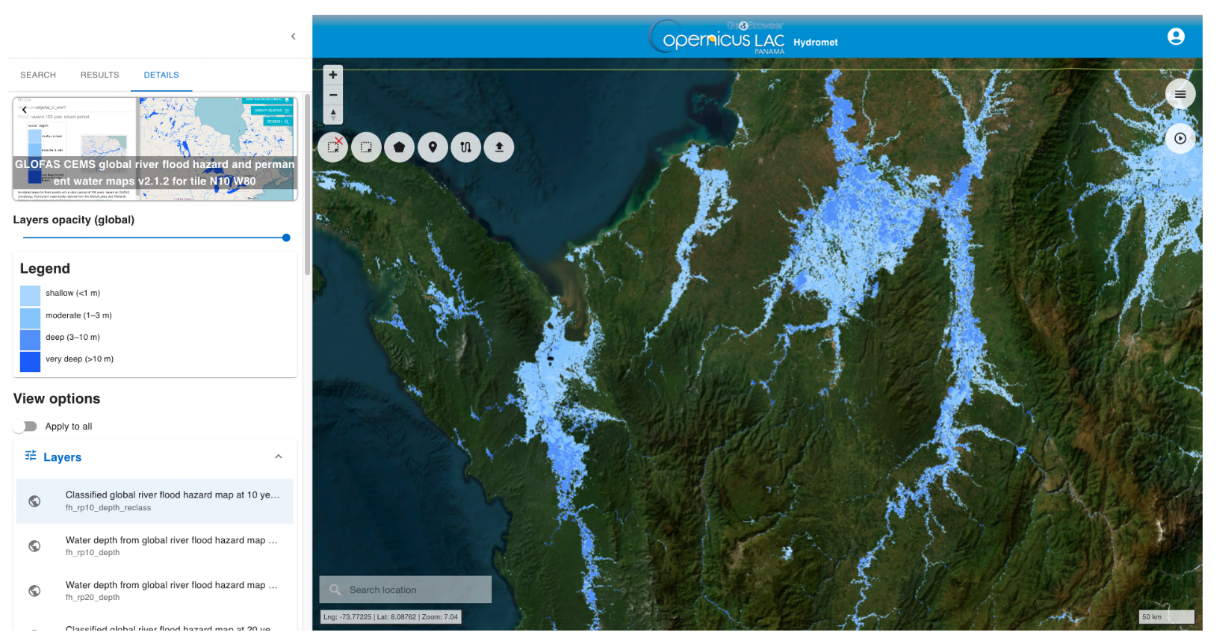
A feature in the GLOFAS collection is made of a single STAC item for each 10x10 deg tile and contains the following single band assets:
-
Water depth (asset
fh_rp10_depth) and categorized water depth map (assetfh_rp10_depth_reclass) at RP 10 years, -
Water depth (asset
fh_rp20_depth) and categorized water depth map (assetfh_rp20_depth_reclass) at RP 20 years, -
Water depth (asset
fh_rp50_depth) and categorized water depth map (assetfh_rp50_depth_reclass) at RP 50 years, -
Water depth (asset
fh_rp75_depth) and categorized water depth map (assetfh_rp75_depth_reclass) at RP 75 years, -
Water depth (asset
fh_rp100_depth) and categorized water depth map (assetfh_rp100_depth_reclass) at RP 100 years, -
Water depth (asset
fh_rp200_depth) and categorized water depth map (assetfh_rp200_depth_reclass) at RP 200 years, -
Water depth (asset
fh_rp500_depth) and categorized water depth map (assetfh_rp500_depth_reclass) at RP 500 years, -
permanent water binary map (asset
permanent-water) (DN=1=permanent-water).
From each STAC item the FHM service employs only the water depth single band asset from each return period (7 assets). All these assets are at 3-arcsecond resolution in geographic coordinates (EPSG=4326).
COPDEM tiles
The service automatically ingest Copernicus GLO-30 Digital Elevation Model STAC items from the cop-dem-glo-30 STAC collection hosted in the CopernicusLAC Platform. Each items contains:
- elevation map (asset
data).
This asset is at 30m resolution in geographic coordinates (EPSG=4326).
Parameters
The FHM service requires only the AOI mandatory parameter described in Table 2.
| Parameter/Input layer | Description | Required | Default value |
|---|---|---|---|
| Area of Interest | Area of interest defined as WKT or as a GeoJSON polygon | YES |
Output
The FHM service provides improved flood hazard maps for nine different return periods (2, 5, 10, 20, 50, 75, 100, 200, and 500 years). The FHM service returns in output a Flood Hazard Map STAC item for each return period. Each STAC item contains the following assets:
-
output Water Depth Map (WDM) (having STAC key
waterdepth), cropped over the user-defined AOI, and given as single-band raster in COG format, -
output Water Surface Elevation (WSE) (having STAC key
wse), cropped over the user-defined AOI, and given as single-band raster in COG format.
In the hydromet workspace of the CopernicusLAC Platform the output Waterdepth layer from the FHM service is rendered in the map using the viridis colormap. The WSE layer asset is rendered using the terrain colormap. For both the layers the legend is also shown in the left panel providing minimum and maximum values in meters.
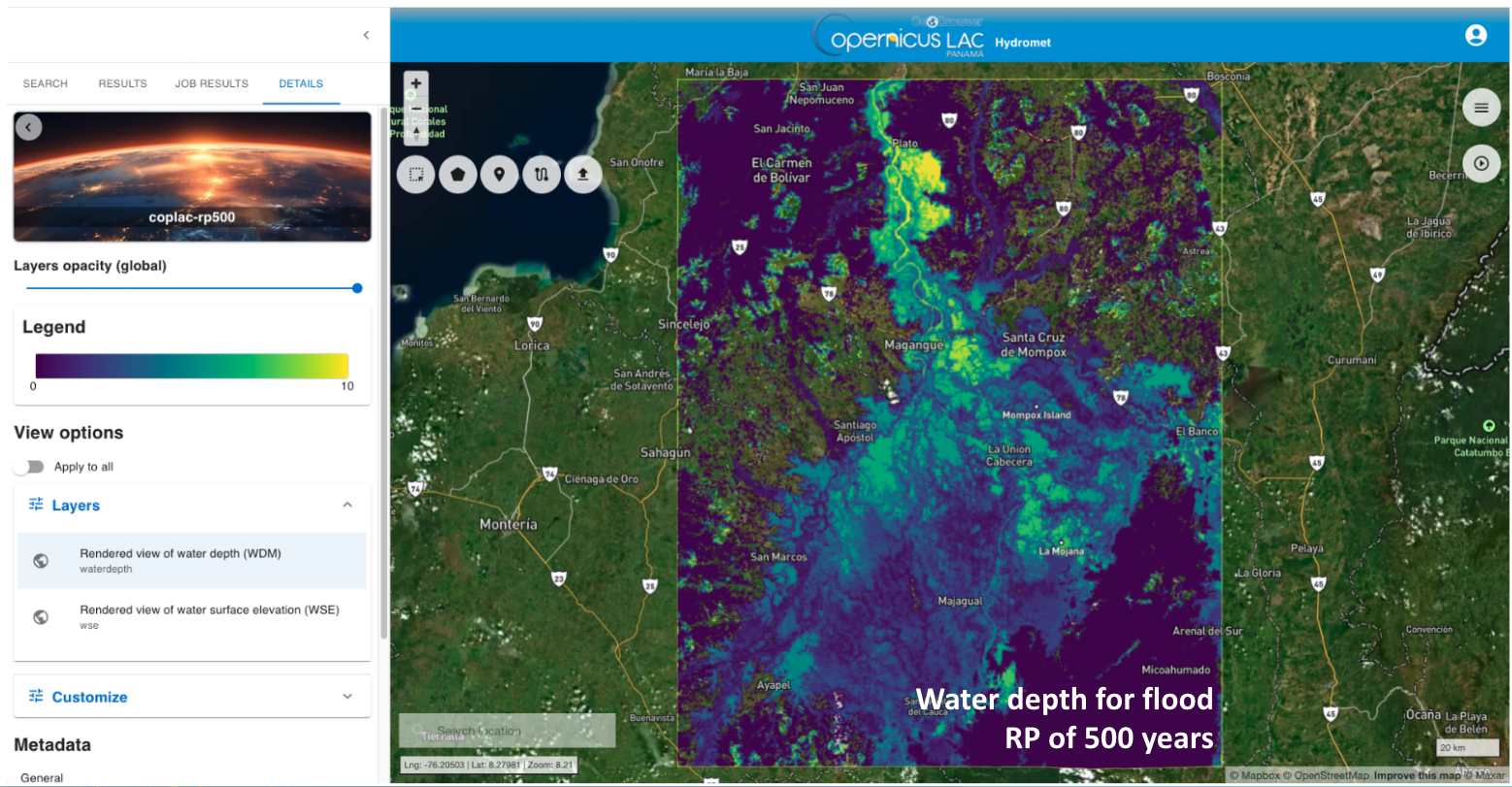
FHM Product Specifications can be found in the below tables.
| Attribute | Value / description |
|---|---|
| Description | Output water depth raster in meters at certain return period over the user-defined AOI. |
| STAC key | waterdepth |
| File name | hazard_depth_rpXXX.tif where XXX = [2, 5, 10, 20, 50, 75, 100, 200, or 500] years |
| Geospatial Data Type | Raster |
| Data Type | Float32 |
| Band | 1 |
| Format | COG |
| Projection | EPSG:4326 - WGS84 |
| No Data Value | nan |
| Attribute | Value / description |
|---|---|
| Description | Output water surface elevation raster in meters at certain return period over the user-defined AOI |
| STAC key | wse |
| File name | hazard_wse_rpXXX.tif where XXX = [2, 5, 10, 20, 50, 75, 100, 200, or 500] years |
| Geospatial Data Type | Raster |
| Data Type | Float32 |
| Band | 1 |
| Format | COG |
| Projection | EPSG:4326 - WGS84 |
| No Data Value | nan |
Service Provider
The service is developed by CIMA Research Foundation, Indra, LIST, and Terradue.
References
-
Baugh, C., Colonese, J., D’Angelo, C., Dottori, F., Neal, J., Prudhomme, C., and Salamon, P.: Global river flood hazard maps, 2024. European Commission, Joint Research Centre. DOI: 10.2905/JRC.VD32YWG Dataset. ↩
-
Pulvirenti L., Squicciarino G., Cenci L., Ferraris L., Virelli M., Candela L., Puca S. Continuous flood monitoring using on-demand SAR data acquired with different geometries: Methodology and test on COSMO-SkyMed images, ISPRS Journal of Photogrammetry and Remote Sensing, Volume 225 (2025). DOI: 10.1016/j.isprsjprs.2025.04.036. ↩
-
Pulvirenti, L., Squicciarino, G., Fiori, E., Ferraris, L., & Puca, S. (2021). “A Tool for Pre-Operational Daily Mapping of Floods and Permanent Water Using Sentinel-1 Data”. Remote Sensing, 13(7), 1342. DOI: 10.3390/rs13071342. ↩
-
Pulvirenti, L., Squicciarino, G., & Fiori, E. (2020). A Method to Automatically Detect Changes in Multitemporal Spectral Indices: Application to Natural Disaster Damage Assessment. Remote Sensing, 12(17), 2681. DOI: 10.3390/rs12172681. ↩
-
Copernicus DEM – Global Digital Elevation Model - COP-DEM_GLO-30. DOI: 10.5270/ESA-c5d3d65. ↩