World Settlement Footprint Tracker layer specifications
Service Description
The World Settlement Footprint Tracker (WSF Tracker) layer is derived from the DLR’s WSF Tracker to provide global, high-resolution settlement extent mapping at a 10m resolution, updated biannually from July 2016 to the present. The WSF Tracker integrates Sentinel-1 (S1) radar and Sentinel-2 (S2) optical imagery to detect and track human settlement growth with unprecedented accuracy. The service leverages this data to offer near-real-time insights into urbanization, which is crucial for urban planning, disaster risk management, and sustainable development, particularly in rapidly urbanizing regions of Latin America and the Caribbean.
Unlike traditional settlement datasets, which often become outdated due to infrequent updates, the WSF Tracker provides timely, consistent, and continuous settlement monitoring. This enables detailed tracking of urban growth, helping stakeholders such as urban planners, policymakers, and disaster managers make informed decisions. Building on the WSF2019 foundation 1, the WSF Tracker leverages temporal statistics such as mean, median, minimum, maximum, and standard deviation extracted from different S1- and S2-based features. In addition to the WSF2019, auxiliary datasets like OpenStreetMap (OSM) building footprints 2, Google Open Buildings 3, and Microsoft Global ML Building Footprints 4 are used in the learning phase to refine the selection of training samples, thereby improving the classification accuracy.
Topographic and road masking are essential steps in ensuring that the final settlement extent map accurately reflects built-up areas. Complex terrains, such as rocky regions, are excluded using SRTM DEM 5 and ASTER DEM 6 data for slope analysis. Additionally, roads are masked using OSM and Facebook’s dataset of roads missing from OSM 7, preventing their misclassification as built-up areas.
The WSF Tracker service is especially beneficial for a variety of applications, including:
-
Urban Growth Monitoring: Tracking urbanization trends in fast-growing regions.
-
Disaster Risk Assessment: Identifying urban expansion in vulnerable areas for better disaster preparedness and response.
-
Sustainable Development: Supporting sustainable urban development by providing up-to-date settlement data.
Workflow
The WSF Tracker relies on a multi-step workflow to accurately map settlement extents. The detailed workflow is as follows:
-
Image Collection:
-
S1 and S2 imagery is collected for each 12-month period, ensuring the comprehensive analysis of settlement dynamics. Rather than relying on a single snapshot, the service extracts temporal statistics (mean, minimum, maximum, median, standard deviation) from the full-year data, which provides a robust representation of settlement behavior.
-
These 12-month temporal statistics are iteratively shifted every 6 months, allowing for biannual updates that reflect the most current changes in settlement extent. This approach ensures that urban growth trends are consistently tracked without being distorted by short-term anomalies, providing a stable and accurate representation of settlements.
-
-
Feature Extraction:
- S1 and S2 imagery are processed to extract a range of features suitable for settlement detection, which capture the distinct characteristics of urban and non-urban land cover. For S1, these are derived from backscattering values and polarimetric decomposition; for S2 different spectral indices are extracted.
-
Training Sample Generation:
-
A training dataset is created by thresholding the extracted features based on regional climate classifications (e.g., Köppen-Geiger 8). The threshold values are customized according to the specific characteristics of the region;
-
Auxiliary datasets, including OSM building footprints, Google Open Buildings, and Microsoft Global ML Building Footprints, are used as references for deriving training samples for the settlement class.
-
-
Random Forest Classification:
- Random Forest classification 9 is applied to the extracted features and training samples to classify each pixel as either settlement or non-settlement. The algorithm builds multiple decision trees during the training phase and outputs the most frequent class (settlement or non-settlement) as the final classification for each pixel.
-
Temporal Consistency:
-
A temporal consistency ruleset is applied to ensure the stability and consistency of classification results over time. This ruleset helps minimize false positives, particularly in regions where seasonal or temporary changes could impact classification results.
-
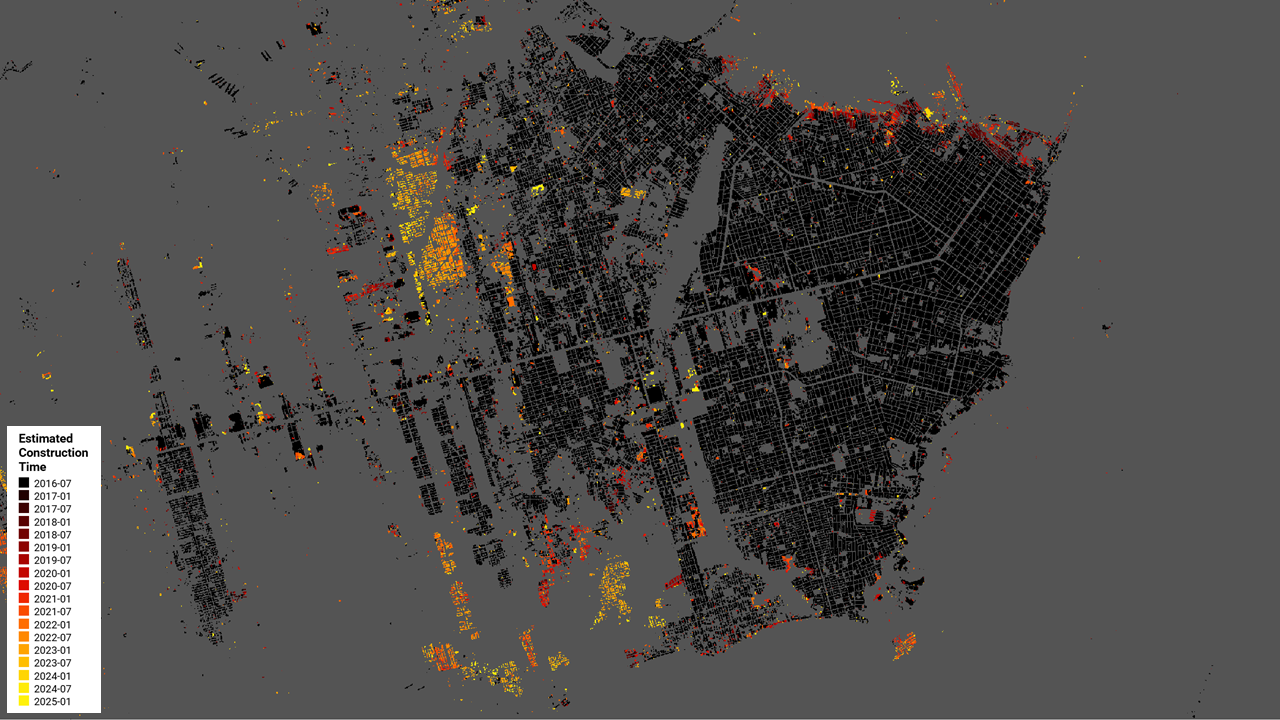
This rule assigns a numerical value to each pixel based on the period during which it was classified as built-up. Value 1 represents pixels identified as built-up areas up to July 2016. Value 2 denotes pixels identified as built-up areas between July 2016 and January 2017, and so on up to (so far) value 18, depicting pixels identified as built-up areas between July 2024 and January 2025.
-
-
Post-Processing:
-
Topographic Masking: SRTM DEM / ASTER DEM data are used to exclude areas with slopes greater than 10°, which could be confused with settlements in radar or optical data, especially in complex topography.
-
Road Masking: OSM and Facebook’s dataset of roads missing from OSM are used to mask out roads, which might otherwise be misclassified as settlements.
-
Input
The following inputs are needed to generate this layer:
Sentinel imagery:
-
Sentinel-2 L2A: One year of imagery is used for each update. Temporal statistics are computed over a shifting 12-month window, capturing changes in settlement extent across multiple 6-month periods.
-
Sentinel-1 GRD: One year of imagery is used for each update. Temporal statistics are computed over the same shifting 12-month window every 6 months, capturing changes in the settlement extent.
Ancillary data:
-
OSM: Building footprint data and road network data, which help refine settlement boundaries and prevent roads from being misclassified as settlements.
-
Google Open Buildings: Building footprint data for training sample generation.
-
Microsoft Global ML Building Footprints: Additional building footprint data for training sample generation.
-
SRTM DEM / ASTER DEM: Digital Elevation Model for topographic masking.
-
Facebook Road Dataset: Used for road masking, ensuring roads are not misclassified as settlements.
Parameters
The following parameters are needed to generate this layer:
- Area of Interest (AOI): the geographical region to be analyzed.
Output
The settlement extent map consists of:
-
Definition: The output map represents the extent of settlements with numerical values corresponding to the period when the settlement is estimated to be constructed (Value 1 represents pixels identified as built-up areas up to July 2016. Value 2 denotes pixels identified as built-up areas between July 2016 and January 2017, and so on up to (so far) value 18).
-
Data type: Geospatial layers
-
Format: raster file
-
Spatial resolution: 10m.
-
Frequency: bi-annual.
-
Spatial coverage: Global.
-
Temporal coverage: From July 2016 to present.
-
Constraints: availability of EO acquisitions.
Service Provider
The layer is developed by DLR.
Back to Exposure Mapping services
References
-
Marconcini, M.; Metz-Marconcini, A.; Esch, T.; Gorelick, N. (2021). Understanding Current Trends in Global Urbanisation – The World Settlement Footprint suite. GI_Forum, 1, 33-38. ↩
-
OpenStreetMap contributors. (2025). OpenStreetMap: Planet dump. Distributed under the Open Data Commons Open Database License (ODbL). Retrieved from https://www.openstreetmap.org. ↩
-
Google. (2022). Open Buildings dataset. Version 3. Released under CC BY 4.0. Available at: https://sites.research.google/open-buildings/. ↩
-
Microsoft. (2023). Global Machine Learning Building Footprints. Released under the Open Data Commons Open Database License (ODbL). Retrieved from https://github.com/microsoft/GlobalMLBuildingFootprints. ↩
-
NASA JPL. (2013). NASA Shuttle Radar Topography Mission (SRTM) 1 Arc-Second Global. Distributed by NASA EOSDIS Land Processes DAAC. DOI: 10.5067/MEaSUREs/SRTM/SRTMGL1.003. ↩
-
NASA/METI/AIST/Japan Spacesystems and U.S./Japan ASTER Science Team. (2019). ASTER Global Digital Elevation Model (GDEM) Version 3. Distributed by NASA EOSDIS Land Processes DAAC. DOI: 10.5067/ASTER/ASTGTM.003. ↩
-
Facebook AI. (2020). Map with AI - RapiD and Missing Roads Dataset. Facebook AI and OpenStreetMap. Available at: https://mapwith.ai/. ↩
-
Beck, H. E., Zimmermann, N. E., McVicar, T. R., Vergopolan, N., Berg, A., & Wood, E. F. (2018). Present and future Köppen-Geiger climate classification maps at 1-km resolution. Scientific Data, 5, 180214. https://doi.org/10.1038/sdata.2018.214. ↩
-
Breiman, L. (2001). Random Forests. Machine Learning, 45(1), 5–32. https://doi.org/10.1023/A:1010933404324. ↩